When Truck Stop Slang Meets Traffic Light Confusion, Two Classic Roadside Jokes Reveal How Misunderstandings, Quick Wit, and Everyday Humor Turn Ordinary Moments With Truckers, Diners, and Strangers Into Timeless Stories Passed Along America’s Long Highways
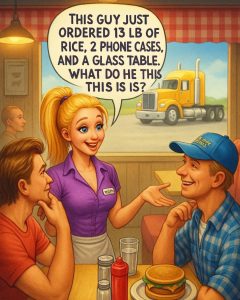
The truck stop café had seen every kind of traveler imaginable, but the morning the trucker walked in and gave his order still stood out. He didn’t glance at the menu or hesitate like most newcomers. Instead, he leaned on the counter and confidently said, “I’ll have three flat tires, a pair of headlights, and a pair of running boards.” The young blonde waitress, new to the job and eager to prove herself, froze for a moment. Her mind raced as she tried to process whether she had misheard him or whether this man genuinely believed he had walked into an auto parts shop instead of a diner. Fighting embarrassment, she smiled politely and hurried back to the kitchen, where she asked the cook in a whisper if this was some kind of prank. The cook burst out laughing, wiping his hands on his apron before explaining that three flat tires meant pancakes, headlights meant sunny-side-up eggs, and running boards were strips of crispy bacon. It was diner slang, passed down through decades of truckers who spent their lives on the road.
Relieved but still slightly flustered, the waitress nodded and went to prepare the order. As she worked, she couldn’t help thinking about how strange and funny the language of the road could be. Truckers had their own shorthand for almost everything, and this café was one of the few places where that language still thrived. Just as she was about to carry the plate out, inspiration struck. Wanting to add a personal touch and still slightly amused by the mechanical theme, she scooped a bowl of beans and added it to the tray. When she placed the food in front of the trucker, he raised an eyebrow and asked, “What are the beans for?” Without missing a beat, she smiled brightly and replied, “Well, I figured while you’re waiting for your flat tires, headlights, and running boards, you might as well gas up.” The trucker laughed so hard that nearby customers turned to look, and the café filled with the easy warmth that only a good joke can bring.
That same kind of misunderstanding, built on good intentions and missing context, plays out far beyond the walls of diners. On a snowy day, a trucker found himself stopping at one red light after another as traffic crawled through town. At the first light, a blonde woman jumped out of her car, tapped on his window, and said cheerfully, “Hi, my name is Heather, and you are losing some of your load.” The trucker, tired and focused on the road, simply stared ahead and waited for the light to change. At the next intersection, there she was again, repeating the same line with growing urgency. By the third stop, she took a deep breath, knocked firmly, and delivered her warning once more, clearly convinced she was helping prevent a disaster.
Finally, the trucker rolled down his window and smiled calmly. “Hi, my name is Kevin,” he said, gesturing toward the sky. “It’s snowing, and I’m driving a salt truck.” In that instant, confusion dissolved into laughter. What Heather thought was a failing load was simply salt doing exactly what it was supposed to do. Like the diner slang, the situation highlighted how easily meaning can be lost when people don’t share the same frame of reference. Neither person was foolish; they were just operating with different assumptions.
These stories endure because they capture something universal. Life is full of moments where people speak different languages without realizing it—sometimes literally, but more often culturally or contextually. Truckers develop shorthand based on long hours, shared experiences, and practical humor. Diners and roads become stages where these small misunderstandings play out, usually ending not in conflict, but in laughter. The humor isn’t cruel; it’s gentle, rooted in surprise and the sudden realization that the world is bigger and stranger than we expect.
What makes these jokes especially lasting is their warmth. They don’t rely on anger or embarrassment, but on the joy of recognition. The waitress isn’t mocked for being new, and Heather isn’t ridiculed for caring. Instead, both are part of a moment that brings people together through shared laughter. In a world that often feels divided, these simple exchanges remind us how easily humor can bridge gaps between strangers.
In the end, these roadside stories aren’t really about truckers, diners, or traffic lights. They’re about communication, perspective, and the kindness hidden inside everyday misunderstandings. Whether it’s ordering breakfast like auto parts or mistaking falling salt for a lost load, the result is the same: a moment of connection that turns an ordinary day into a story worth retelling. And on long highways and in quiet cafés, those stories travel almost as far as the trucks themselves.
Summary
Two classic jokes—one set in a truck stop café and another at snowy traffic lights—highlight how misunderstandings rooted in different perspectives can turn into moments of humor and connection. Through diner slang and roadside confusion, the stories celebrate kindness, quick wit, and the shared laughter that brings strangers together.