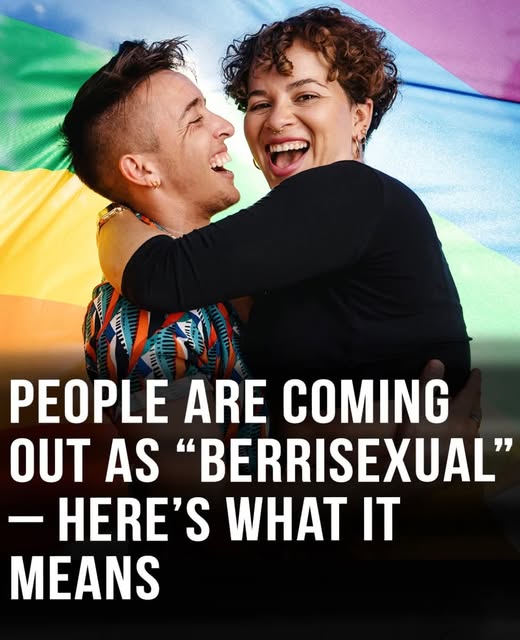
Berrisexuality is a term that has quietly but steadily entered contemporary conversations about attraction, identity, and self-understanding, reflecting a broader cultural shift toward more precise and flexible language. It is most often used by people who experience attraction to all genders, yet feel a stronger, more consistent pull toward women, feminine-aligned individuals, and androgynous people. Rather than describing exclusion, the term captures emphasis—an unevenness that feels intrinsic rather than accidental. For many, this pattern of attraction has existed for years, sometimes decades, without a satisfying way to describe it. They knew their attraction was not limited to a single gender, but they also knew it was not evenly distributed. Berrisexuality offers language for that lived reality, one that neither denies breadth nor forces symmetry where none exists. As discussions around sexuality continue to move away from rigid categories, the rise of such micro labels reflects a deeper desire for honesty, self-accuracy, and emotional coherence rather than novelty for its own sake.
For a long time, broader identities such as bisexuality and pansexuality served as essential umbrellas, creating space for people whose attractions exceeded binary definitions. For many, those labels still fit well and remain deeply meaningful. Yet others have found that these identities, while broadly accurate, left something unspoken. The assumption of equal or interchangeable attraction, often projected onto those labels by both outsiders and community members, did not always match internal experience. Someone might feel drawn to women with intensity, frequency, and emotional depth, while attraction to men appeared more sporadic, situational, or subdued. Without language to express this imbalance, people sometimes questioned themselves or felt as though they were somehow “doing” their identity incorrectly. Berrisexuality does not replace bisexuality or pansexuality so much as it refines the conversation, allowing people to articulate attraction as it is actually felt rather than as it is expected to appear.
The growing visibility of berrisexuality is inseparable from the internet, where identity exploration often unfolds collectively rather than in isolation. Online forums, social platforms, and queer-focused wikis have become spaces where people compare experiences, test language, and discover unexpected points of resonance. Many describe encountering the term for the first time as a moment of recognition rather than revelation. It did not introduce something new; it named something familiar. Reading others describe the same imbalance, the same quiet preference that never erased attraction to men but rarely centered it, brought relief. In these digital environments, berrisexuality emerged less as a top-down classification and more as a shared shorthand developed organically by people trying to describe themselves more truthfully. The sense of community that forms around such terms often matters as much as the label itself, reinforcing the idea that nuance is not isolation, but connection through specificity.
Critics of micro labels sometimes argue that increasingly detailed terminology fragments identity or creates unnecessary divisions. Supporters counter that the opposite is often true. For those who resonate with berrisexuality, the term reduces internal conflict rather than creating it. Instead of constantly explaining caveats—“I’m attracted to all genders, but mostly…”—the label carries that meaning within it. Importantly, most people who use or support the term emphasize that it is optional. No one is required to adopt micro labels, and no identity becomes invalid without them. Berrisexuality is best understood as a tool, not a rule: a way to communicate experience more accurately when broader language feels insufficient. In that sense, its rise reflects not a crisis of identity, but a maturation of it, where personal truth is valued over conformity to simplified categories.
At a deeper level, the popularity of berrisexuality speaks to a cultural reevaluation of how attraction itself is understood. Attraction is not merely about who one could be drawn to in theory, but about patterns, frequency, emotional gravity, and lived experience. By acknowledging directional pull without exclusion, berrisexuality challenges the idea that attraction must be evenly balanced to be legitimate. It validates the reality that desire often has contours, weight, and preference without becoming restrictive. For many, this recognition alleviates years of quiet self-doubt, replacing questions of legitimacy with acceptance of complexity. Rather than framing uneven attraction as confusion or indecision, berrisexuality reframes it as a stable, coherent experience deserving of its own language.
Ultimately, berrisexuality is less about creating a new box and more about loosening old ones. It reflects a broader movement toward self-description that prioritizes accuracy, consent, and self-knowledge over external expectations. As conversations around gender and sexuality continue to evolve, terms like berrisexuality demonstrate how language adapts to human experience rather than the other way around. For those who see themselves reflected in it, the label does not limit possibility; it clarifies reality. It offers reassurance that attraction does not need to be symmetrical to be valid, nor undefined to be free. In giving shape to nuance, berrisexuality affirms that complexity is not a flaw in identity, but one of its most honest expressions.