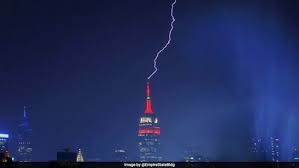
What began as a typical New Year’s Day quickly turned into a day of fear and uncertainty. January 1, 2025, was supposed to be a day of celebration, reflection, and the quiet beginnings of resolutions for millions of Americans. Streets were still wet with early morning dew, smoke from backyard fireworks lingered in the air, and families gathered to share breakfast, hugs, and greetings for the year ahead. Few expected that the first day of the year would become etched in memory as a day of chaos, terror, and confusion. Across the country, three devastating attacks struck separate locations, each preceded by a strange and intense display of lightning that lit the sky in a way that eyewitnesses described as eerie, unnatural, almost otherworldly. Initially, many assumed it was coincidence, a rare and strange weather phenomenon occurring at an unfortunate time. But as the day unfolded, what seemed like randomness quickly evolved into alarming patterns that left citizens and authorities alike questioning the very nature of what had happened.
The first reports began to surface just after dawn. Residents in a major metropolitan area reported sudden, blinding flashes of lightning that seemed too intense for the cloud cover present. Windows rattled, and thunder rolled with a ferocity that suggested an approaching storm, though the skies were largely clear. Moments after the lightning struck, an explosion shook a nearby commercial district. Emergency calls flooded dispatch centers, describing panic, debris, and smoke rising from the street. Ambulances, fire trucks, and police vehicles scrambled to the scene as sirens pierced the early morning calm. Citizens captured video footage, some posting to social media immediately, showing not only the aftermath of the explosion but also the strange lightning flashes that had preceded it. Experts on meteorology later reviewed these clips, noting the lightning was of unusual intensity and frequency, far beyond what would be expected in a clear-sky environment. Many wondered whether the lightning itself was purely natural—or somehow connected to the attacks that followed.
Hours later, a second attack occurred on the opposite side of the country, in another major urban area. Here too, residents witnessed sudden, violent lightning strikes. Windows shook, streetlights flickered, and the sky illuminated with harsh, jagged streaks of electricity before the chaos erupted. This second attack took place in a crowded public space, leaving scores injured and prompting a massive emergency response. Eyewitnesses described confusion and fear as they sought shelter, with many noting the eerie coincidence of lightning preceding the event. Videos captured the scene: frightened civilians running through streets as emergency personnel tried to secure the area. Social media feeds quickly filled with hashtags referencing the “lightning attacks,” as people debated whether these events were connected or simply a series of improbable coincidences. By this point, authorities could no longer dismiss the possibility that a pattern was emerging—an unsettling synchronicity that raised concerns about coordinated attacks or unforeseen phenomena at play.
By the afternoon, a third attack struck a third location, this time near a transportation hub in another part of the country. Once again, the lightning arrived first, a dramatic, almost cinematic display in the sky that had, in the previous attacks, signaled chaos moments later. Officials confirmed that all three incidents occurred within a remarkably short window, with timing precise enough to defy simple explanation. Each attack differed in scale and target but shared the same unsettling prelude: intense, seemingly unnatural lightning flashes. First responders were stretched thin, moving from one scene to the next as the public struggled to comprehend the scale of what was unfolding. Hospitals reported influxes of injured citizens, emergency services coordinated to support overwhelmed areas, and the federal government quickly mobilized crisis response teams. Analysts would later describe this as one of the most perplexing and alarming national emergencies in recent memory, not just for the attacks themselves but for the bizarre circumstances that accompanied them.
The human element of the day was vivid and visceral. Witnesses recounted panic, fear, and confusion as they attempted to navigate streets suddenly transformed into scenes of disaster. Families huddled in homes, unsure whether to evacuate. Children, frightened by the combination of thunderous lightning and distant explosions, clung to parents while local authorities issued guidance via emergency alert systems. The psychological impact was immediate: fear rippled across social networks, television broadcasts, and radio channels. Experts in trauma and crisis response emphasized that the human reaction to such events often intensifies when unusual, seemingly inexplicable phenomena are involved. Lightning, already an awe-inspiring natural occurrence, added a layer of supernatural tension to the day’s events, leaving ordinary citizens questioning not only their physical safety but the very nature of reality in moments of extreme stress.
Social media played an enormous role in shaping public perception throughout the day. Videos of the lightning flashes went viral within minutes of each attack, often paired with shaky cellphone footage of the aftermath. Eyewitnesses shared first-hand accounts of chaos, fear, and confusion, creating a swirl of information that was as overwhelming as it was immediate. While some content was accurate, much of it was speculative, sensationalized, or misleading. Conspiracy theories began circulating almost immediately, connecting the lightning to everything from secret military experiments to apocalyptic prophecies. Scientists and meteorologists quickly issued statements urging calm, emphasizing that while the lightning’s timing was unusual, there was no verified evidence linking the electrical phenomena to the attacks. Authorities repeated this message, asking the public to rely on official channels for information, while simultaneously investigating the possibility of coordinated attacks. The sheer volume of online content underscored a critical truth about modern emergencies: information spreads faster than the crisis itself, shaping perception and panic in real time.
In the hours following the attacks, federal and local authorities worked tirelessly to piece together what had happened. Emergency services coordinated medical aid, law enforcement investigated potential perpetrators, and cybersecurity experts monitored communications for signs of further threats. Analysts poured over surveillance footage, lightning strike data, and eyewitness accounts, attempting to determine whether there was any tangible connection between the natural phenomenon and the human-driven events. Intelligence agencies emphasized caution: premature conclusions could exacerbate fear or lead to false narratives, yet the public’s demand for answers grew by the hour. Community leaders held press conferences, urging calm and resilience while assuring citizens that every resource available was being mobilized to prevent further incidents.
The broader implications of the day became clear as the initial shock began to subside. Questions about infrastructure, emergency preparedness, and public safety dominated conversations. How should cities respond to unusual weather phenomena coinciding with human threats? Could early warning systems for lightning be adapted to provide additional public safety alerts? Should authorities increase surveillance or intelligence monitoring in response to patterns that may—or may not—be meaningful? Policymakers and experts emphasized the need for balanced responses, highlighting both the necessity of preparedness and the dangers of overreaction. In parallel, social scientists studied the public’s behavior, noting how fear spread through communities and digital networks, amplifying anxiety far beyond the immediate impact zones. The events served as a stark reminder that in today’s interconnected world, emergencies are not confined to geography—they ripple outward, affecting perception, policy, and collective psychology.
Public reactions were varied. Many Americans expressed fear, confusion, and frustration at the seeming randomness of the attacks and the eerie lightning. Others sought solace in community, helping neighbors, volunteering, and ensuring that vulnerable populations were safe. Religious and spiritual leaders provided guidance, framing the day as a moment to reflect on resilience, solidarity, and preparedness. Educational institutions temporarily adjusted schedules to accommodate counseling and safety discussions, while local governments reviewed emergency response protocols to assess gaps exposed by the day’s events. Businesses faced disruptions as employees sought reassurance and protection, with many organizations implementing contingency plans to ensure continuity amidst uncertainty. Across every sector of society, the day underscored the unpredictable nature of both human and natural threats, highlighting the importance of adaptability, preparedness, and vigilance.
Experts have continued to analyze the lightning itself, seeking to understand whether these were rare natural occurrences or part of a broader pattern that might indicate new atmospheric phenomena. Preliminary findings suggest that while unusually powerful, the lightning did not show clear signs of artificial manipulation or tampering. However, the coincidence of timing with multiple attacks remains a subject of study, raising questions about probability, chaos theory, and human perception. Sociologists, psychologists, and emergency planners alike have examined the events to understand the interplay between natural phenomena and societal reaction. The findings, ongoing and complex, contribute to a growing body of knowledge about how humans interpret coincidences and make sense of uncertainty during crises.
As investigations continue, officials urge the public to remain calm, follow safety guidance, and rely on verified information from trusted sources. Rumors, while inevitable, can magnify fear and complicate emergency response efforts. Authorities emphasize that while the lightning was unusual and striking, the immediate priority is ensuring public safety, supporting victims, and preventing further incidents. Communities have begun to organize local initiatives to enhance awareness, encourage emergency preparedness, and build networks of support that can respond quickly in future crises. These efforts underscore the importance of collaboration, vigilance, and thoughtful action in maintaining safety and resilience in uncertain times.
The events of January 1, 2025, are a sobering reminder of how rapidly crises can unfold. In less than a day, ordinary lives were disrupted, communities were shaken, and national attention focused on the intersection of natural and human-driven phenomena. While investigations continue, the lessons are clear: vigilance, preparation, and reliance on verified information are essential. Lightning may be a force of nature, unpredictable and awe-inspiring, but human response determines whether fear dominates or resilience prevails. In a world where events can strike without warning, understanding, adaptability, and collective action remain the strongest defenses against chaos and uncertainty.