Tattoos and body markings have been part of human culture for thousands of years. Across continents, languages, and civilizations, people have used their skin as a canvas to express identity, belief, sorrow, strength, faith, and connection.
Some markings symbolize coming-of-age rituals, others honor the dead, while many carry personal stories too private for words. It is fascinating that the same tattoo can communicate different meanings depending on the culture.
What is celebrated in one region may be misunderstood in another. A simple shape can hold centuries of tradition, while a complex pattern might be dismissed as decoration by people unfamiliar with its origins.
And because human beings have always expressed themselves visually, body art has become a universal form of storytelling — one that transcends distance, language, and time. In the modern world, tattoos are everywhere.
Some people ink their skin out of spontaneity or youthful impulse; others choose their designs with great care, selecting symbols that represent healing, love, loss, transformation, or spiritual awakening.
And every so often, a certain tattoo appears so frequently that it raises a natural curiosity. Why are so many people choosing it? What does it actually represent? What meaning lies beneath the surface?
One such design is the “red string of fate” tattoo.
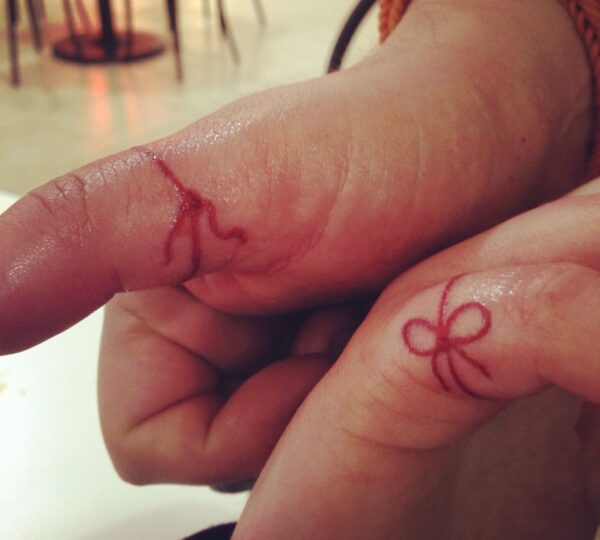
Many people have seen it — a small, simple bow-like red string placed on a finger, usually on the pinky of a woman or the thumb of a man. It looks delicate, almost like a ribbon tied around the skin. At first glance, it may seem like an aesthetic choice, a minimalist accessory. But this symbol carries a story far older and deeper than its modest appearance suggests.
For years, I noticed it on different people — co-workers, strangers in cafés, travelers on trains. The placement and design were consistent enough that it didn’t feel random. It had to mean something. Yet I never paused to look it up or ask anyone about it. Until recently.
When I finally researched it, I discovered an entire world of mythology, symbolism, and cultural tradition tied to this little red string. The tattoo is far more than an artistic flourish — it comes from a powerful ancient story rooted in Asian folklore.
In East Asian cultures, especially Chinese and Japanese mythology, the “red string of fate” represents a mystical bond that connects two people who are destined to be in each other’s lives. According to legend, every person is tied to another by an invisible red thread. Time, distance, conflict, or circumstance cannot break this connection.
No matter how far apart they roam, no matter how drastically their lives change, the destined pair will eventually cross paths. The red string may stretch, tangle, or pull — but it will never snap.
The myth often centers around a supernatural matchmaker, sometimes referred to as the “Old Man Under the Moon,” who is believed to hold the book of marriages. He alone knows the identity of each person’s destined partner, and he binds their fates together with this invisible red string. For many, the idea is profoundly comforting — a reminder that love cannot be lost, only delayed.
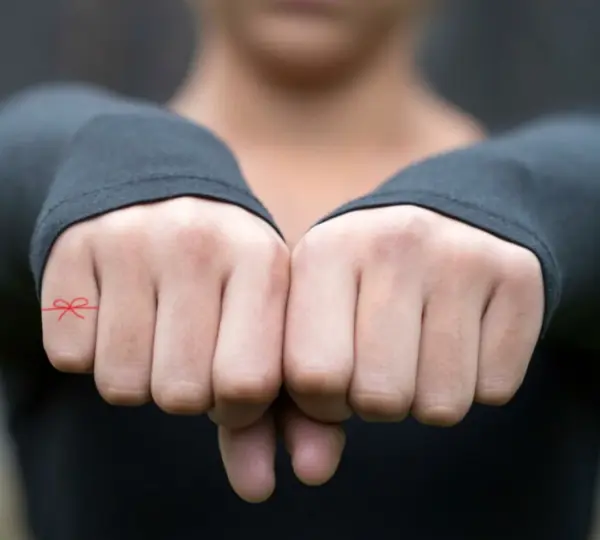
The placement of the tattoo on different fingers also carries meaning. Traditionally, men wear the “string” on their thumb and women on their pinky.
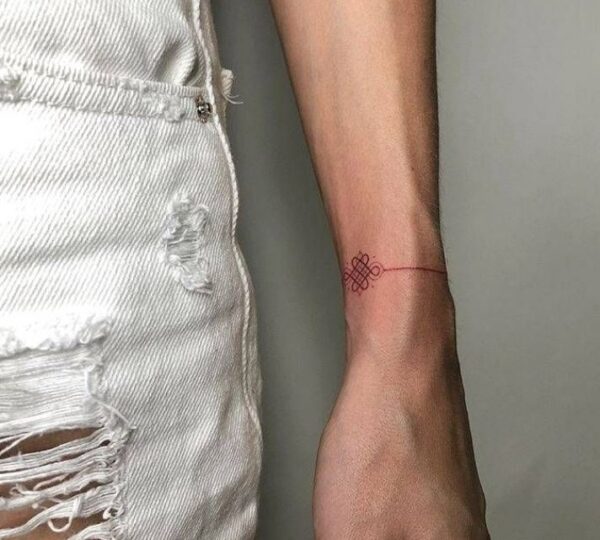
This mirrors the folklore imagery, where the matchmaker ties the red thread between these two fingers to represent eternal connection. Modern variations of the tattoo sometimes place the string on the wrist or around the ankle, but the symbolism remains the same: destiny, love, and the belief that certain souls are meant to collide.
In a world filled with uncertainty, heartbreak, and change, the red string of fate offers a poetic reassurance — that somewhere out there, someone is woven into your story, and you into theirs.
But the symbolism is not limited to romance. Many people choose the tattoo to honor friendships, family bonds, spiritual partners, or even loved ones who have passed away. In that interpretation, the red string becomes a reminder that connection transcends the physical world, reaching across time, memory, and loss.
Across cultures, there are similar beliefs. In Greek mythology, the concept of fate is controlled by the Moirai, the three sisters who weave the threads of human destiny. In some Native cultures, red thread represents protection. In Hebrew tradition, a red string tied around the wrist is believed to ward off negativity and misfortune. And in modern Western symbolism, “being tied together” often suggests emotional or spiritual closeness.
Perhaps that explains why so many people choose this tattoo: it is small, but full of meaning. Minimalist, but deeply emotional. Simple, but rich with the idea that our lives intersect with others not by accident, but by design.
Of course, the belief in fate varies from person to person. Some find comfort in the idea that a higher force guides our relationships, that life has a way of bringing the right people to us when the time is right. Others prefer the idea that we shape our own destiny, that love is a choice rather than a predetermined path.
Yet the red string of fate tattoo remains a powerful symbol regardless of belief. It represents hope. It represents connection. And it represents the beautiful possibility that even in a vast, unpredictable world, we are not wandering alone.
The enduring fascination with the red string of fate is not only tied to the myth itself, but also to the emotional landscape it represents. In an age where relationships can feel fragile, digital, or fleeting, the idea of a connection that cannot be severed resonates more powerfully than ever. And so, the tattoo has evolved beyond an ancient symbol — it has become a modern declaration of faith in connection, destiny, and unseen bonds that shape our lives long before we realize it.
Across countries and generations, this simple red mark carries layers of meaning that reach far beyond romance. In fact, many people who choose the tattoo say that they never viewed it as a symbol of romantic fate at all. Instead, they associate the red string with the people who shaped their lives — a beloved parent, a childhood friend, a mentor, or even a spiritual guide whose influence was profound but subtle.
For others, the red string becomes a remembrance — a way to honor someone they lost yet still feel tied to. It can represent the belief that even after death, the connection remains unbroken. Because in many versions of the legend, the string is not bound by mortal experience; it stretches across lifetimes, connecting souls that are linked beyond physical existence.
The beauty of this interpretation is that it turns the tattoo into a story of healing. People who have gone through grief often describe the red string as a reminder that love does not disappear — it simply changes form. And for individuals emerging from heartbreak, trauma, or separation, the symbol becomes a promise that their story isn’t over yet.
A Symbol of Personal Transformation
While most discussions focus on the tattoo’s connection to love and destiny, many wear it for deeply personal reasons. Some see the red string as a marker of inner rebirth — a reminder that they are tied not only to others, but also to their own past selves. In this sense, the tattoo becomes a thread linking who they once were to who they are becoming.
For people who have survived adversity — illness, loss, betrayal, addiction, or hardship — the tattoo can represent endurance. The red string becomes a metaphor for continuity, a symbolic proof that even when life twists and knots in unimaginable ways, the thread never breaks. It carries them from one chapter to the next, and keeps them connected to the resilience that helped them survive.
Cultural Evolution and Modern Reinterpretation
What makes the red string tattoo particularly unique is the way it has evolved across cultures without losing its essence. In traditional Chinese folklore, the red thread is tied by a lunar matchmaker. In Japan, it is woven through the “pinky promise” culture — a gesture of trust, sincerity, and unbreakable vows. In Korea, the concept blends seamlessly with stories about soulmates and long-lost lovers.
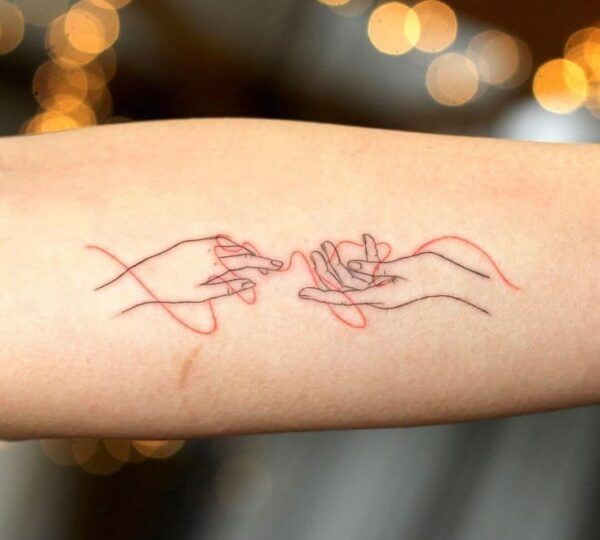
Meanwhile, in Western countries, the tattoo has become symbolic of emotional connection in a more general sense. It can speak to friendships, family, or meaningful encounters that alter one’s direction in life. The modern interpretation is fluid — open, adaptive, accessible to anyone who resonates with the idea of invisible bonds.
And this is where the tattoo becomes especially powerful:
It belongs to everyone who sees themselves in its message.
People at different stages of life reinterpret the same symbol in different ways:
-
Young adults may see it as hope — a reminder that meaningful relationships await.
-
Parents may see it as the invisible bond connecting them to their children.
-
Partners may view it as a tribute to a love that survived storms.
-
Widows, widowers, or those who have lost loved ones may see it as an everlasting connection.
-
Friends separated by continents may wear it as a symbol of enduring closeness.
No matter the interpretation, the red string carries a message that transcends language and culture:
Some connections are stronger than circumstance.
Why It Continues to Grow in Popularity
In a digital age where relationships begin, end, and evolve through screens, people often crave symbols that feel real, tangible, meaningful. Tattoos fulfill that desire by transforming emotion into art — and the red string, minimalistic and elegant, offers a perfect balance of subtlety and depth.
Its small size makes it ideal for people who want something delicate yet significant. Its simplicity ensures that it remains timeless rather than trendy. And its rich cultural roots give it a depth that resonates with people who crave symbolism in a world that often feels rushed and shallow.
But perhaps the strongest reason for its rising popularity is that the tattoo is open-ended. Unlike highly specific symbols that require explanation, the red string speaks quietly, gently, universally. It invites curiosity without demanding exposure. A stranger might notice it and wonder, but its meaning belongs entirely to the person wearing it.
A Story Written Across Skin
The more people learn about the red string of fate, the more they realize its meaning is not confined to fairy tales. Instead, it reflects something deeply human — the idea that our lives are interwoven with others in ways we may not fully understand until years later.
Think about the unexpected friendships that changed your path.
The relationships that taught you something essential.
The people you met by chance who became irreplaceable.
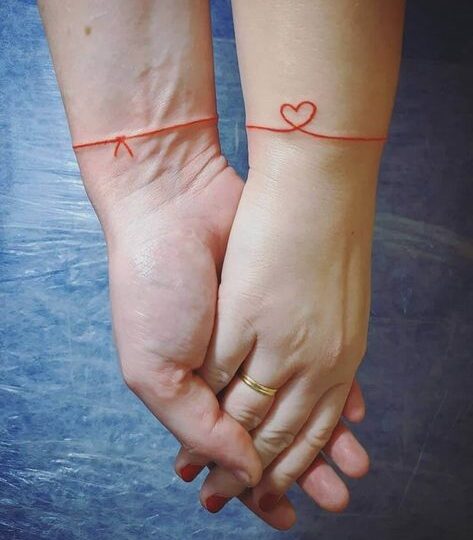
The moments when a stranger stepped into your story at the perfect time.
The loved ones who shaped your heart even after they were gone.
These are the threads of our lives — mysterious, powerful, and often invisible until we look back. The red string tattoo simply makes the invisible visible.
It honors the truth that every person’s life is touched by others, sometimes quietly, sometimes dramatically, but always meaningfully. It celebrates connection, destiny, memory, and the quiet bonds that guide us — not through magic necessarily, but through the natural pull of human relationships.
The Closing Reflection
In its essence, the red string of fate tattoo is a personal declaration of belief — whether that belief is in destiny, love, connection, hope, or the idea that life places the right people in our path at the right time.
It does not matter whether someone embraces the mythology literally or sees it as a poetic metaphor. What matters is the comfort, strength, and meaning it provides.
And that is why this small, delicate red string continues to appear on wrists, pinkies, thumbs, ankles, and hearts around the world:
because every person, at some point in their life, feels the pull of a bond that is too powerful to explain — a bond that feels destined.

