The Quiet Childhood Rituals With My Grandfather That Only Revealed Their True Meaning Years Later, Teaching Me How Love Can Hide Inside Repetition, Memory Loss, and Small Gestures That Protect Connection Long Before We Understand Their Purpose
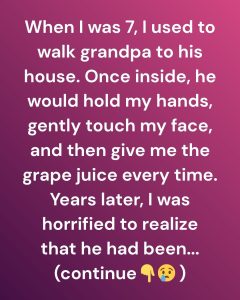
When I was seven years old, visiting my grandfather felt ordinary in the way childhood often turns routine into comfort without explanation. Every week, I would meet him at the corner store, where he waited patiently, hands folded, eyes scanning the street until he saw me. I believed my role was important: I was there to walk him home. He let me lead, matching his slow steps to mine, trusting me completely. At the time, I thought it was a game or perhaps a small responsibility he enjoyed giving me. His house sat quietly at the end of the street, unchanged and modest, smelling faintly of old books and clean laundry. Once inside, the same ritual unfolded every visit. He would take my hands in his, lift his gaze to my face, and study me with an intensity that felt both serious and gentle. Then he would smile, wordlessly, and pour us each a glass of grape juice. We would sit together in silence, the quiet never uncomfortable, his presence wrapping around me like reassurance.
As a child, I never questioned why things happened the way they did. Children rarely do. The ritual felt special, like a secret handshake between us that didn’t require words. My grandfather spoke little, but his attention felt complete. I remember the way his thumbs rested lightly on my hands, the way his eyes softened once he finished looking at me, as though something inside him had settled. The grape juice felt ceremonial, even though I didn’t know why. I simply knew that it mattered. Those afternoons felt safe, predictable, and warm, and in a world that often felt big and confusing, that consistency meant everything. I didn’t know that anything was wrong. I didn’t know there was anything to understand beyond the fact that my grandfather loved me.
As I grew older, life did what it always does—it expanded. School demanded more time. Friends became louder than family routines. Responsibilities replaced rituals. Visits became less frequent, stretched thinner by busy schedules and the quiet assumption that there would always be more time. My grandfather grew quieter still, retreating further into himself. I noticed it, but I explained it away easily. People age. They slow down. That was the story I told myself, because it was simpler than asking questions I didn’t know how to ask. When he passed away, grief arrived mixed with regret. I mourned the man I loved, but I also mourned the visits I’d skipped and the conversations that never happened. Still, I held onto those childhood memories like small, glowing stones—comforting, but unexplained.
Years later, during a casual conversation with my mother about family history, everything shifted. She spoke gently, carefully, as if opening a door she wasn’t sure I was ready to walk through. She told me that during those years when I visited my grandfather weekly, he had already been struggling with memory loss. Some days, he couldn’t remember ordinary details. Some days, he struggled to recognize familiar faces. But he never forgot that I was coming. He knew the day and the time. Holding my hands and studying my face wasn’t habit—it was effort. It was his way of making sure I stayed with him, anchoring me in his memory for as long as he could. The grape juice, she explained, was tied to his medication. Doctors had encouraged it, and sharing it with me transformed something clinical into something joyful.
That realization rewrote my memories completely. Suddenly, every detail carried weight. The way he looked at me wasn’t casual—it was intentional. He wasn’t simply welcoming me; he was memorizing me. The silence wasn’t absence; it was concentration. The ritual wasn’t routine—it was resistance. He was fighting, quietly and stubbornly, against the erosion of memory, using love as his weapon. What I once believed was him trusting me to guide him home was actually him trusting me to walk beside him through something terrifying and unseen. He was holding onto our bond the only way he could, protecting it through repetition and presence.
Now, when I think of my grandfather, I don’t see a quiet old man fading into time. I see someone brave in a way that doesn’t announce itself. Someone who chose love again and again, even as his own mind betrayed him. I understand now that love doesn’t always speak loudly. Sometimes it whispers through routines, hides inside small gestures, and waits patiently for us to grow old enough to understand it. Those childhood visits were never simple. They were acts of devotion, offered without explanation, meant to be understood only when I was ready. And now that I am, I carry them with me—not as questions, but as answers.
Summary
What once seemed like simple childhood routines with a grandfather later revealed themselves as acts of quiet love and resistance against memory loss. Through small gestures and repetition, he preserved connection, teaching that love often reveals its deepest meaning only with time.