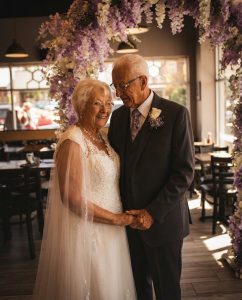
At seventy-one, I truly believed I had reached the gentle ending people talk about when they say life eventually softens. I had buried a husband, raised children alone, endured long years where loneliness felt like a permanent resident in my home, and slowly accepted that romance might belong only to memory. When my first love reentered my life after decades apart, it felt almost unreal, like a chapter that had been bookmarked by fate and finally reopened. We spoke at first like careful strangers, then like old friends, and finally like two people who realized the affection they once shared had never really faded. Our wedding was small, intimate, and deeply emotional, filled with children, grandchildren, and friends who whispered that our story restored their faith in love. Standing there in my simple dress, holding his familiar hand, I felt certain I was safe at last, that life had rewarded my patience with a tender, well-earned joy. I believed the hardest chapters were behind me, that the future would be calm, predictable, and kind. That belief shattered quietly, not with drama or raised voices, but with a single sentence whispered by a stranger during my own wedding reception.
She appeared when the music was playing and glasses were clinking, a young woman I had never seen before, her expression serious in a room full of laughter. She stepped close enough that only I could hear her and said, “You don’t really know him,” before pressing a folded piece of paper into my palm and walking away as if she had simply delivered a message meant for someone else. For the rest of the night, I moved through the reception like an actress who had forgotten her lines. I smiled for photographs, hugged relatives, and listened to toasts praising our resilience, all while my heart pounded with a fear I hadn’t felt in years. Every laugh my new husband shared with my children felt suddenly suspicious, every affectionate gesture shadowed by doubt. The address in my pocket weighed more than anything I had ever carried. I told myself I was too old for secrets, too tired to ignore warnings simply because facing them felt uncomfortable. After surviving loss and rebuilding my life once already, I knew one thing with absolute clarity: I would rather face a painful truth than live inside a beautiful lie.
The next day, I drove alone, my hands gripping the steering wheel so tightly my knuckles ached. I rehearsed every possible outcome in my mind, from discovering a hidden family to uncovering a past so dark it would shatter the fragile happiness I had just reclaimed. When I arrived at the address, confusion washed over me first. The building was unmistakably my old high school, restored and glowing softly in the afternoon light, now transformed into a restaurant and event space. Before I could leave or question my sanity, the doors opened, music began to play, and confetti floated down from above. Faces I loved emerged from behind pillars and doorways, smiling, crying, clapping. The young woman from the wedding stepped forward, suddenly warm and apologetic, explaining that she was an event planner hired months earlier. What followed left me breathless: my husband had remembered a conversation from years ago, when I once admitted with quiet sadness that I had never attended my high school prom because of family hardship. He had carried that regret with him, waiting for the right moment to give me something time had taken away.
That afternoon unfolded like a dream stitched together from memory and intention. The gymnasium-turned-dance floor glowed with soft lights, a band played music from our youth, and our family watched as we stepped onto the floor together. Dancing there, where we had once passed shy glances as teenagers, felt like reclaiming a piece of myself I thought was lost forever. I realized how close I had come to misunderstanding love’s quiet gestures, mistaking secrecy for betrayal when it was, in fact, devotion preparing a surprise. The warning that had nearly unraveled my joy became a lesson instead, reminding me how fear can echo louder than trust when we have been hurt before. In that moment, I felt something profound settle inside me: love is not always loud or obvious, and sometimes it moves carefully, protecting joy until the moment it can be fully revealed.
Looking back, I understand how fragile happiness can feel after a lifetime of loss. When you have survived grief, your instinct is to guard what little joy you find, even if that means suspecting it might disappear. The stranger’s warning tapped directly into that instinct, awakening the part of me that had learned to prepare for disappointment. Yet what my husband showed me that day was not just romance, but attentiveness, memory, and respect for the woman I had been before life hardened me. He didn’t erase my past or rush me toward a future; he honored the spaces in between, the missed moments, the quiet regrets that lingered beneath my smiles. At an age when society often suggests surprises are behind us, he proved that thoughtfulness does not expire, and neither does wonder.
At seventy-one, I learned that love is not defined by timing, but by intention. It can arrive late, dressed in familiarity, carrying decades of shared history and unspoken understanding. It can stumble, be tested by fear, and still emerge stronger when truth is revealed. My wedding day did not just mark a marriage; it marked a reckoning with my own assumptions about safety, trust, and what I believed I deserved at this stage of life. I discovered that being seen does not always look like certainty; sometimes it looks like vulnerability, like choosing to investigate a fear instead of burying it. And in the end, I learned something quietly extraordinary: even late in life, love can still surprise us, heal old wounds, and remind us that some of the most beautiful moments are the ones we never expected to receive at all.