At first glance, the viral image appears completely ordinary: a worn, slightly damaged pair of shorts laid out flat. The fabric looks aged, and there are visible tears near the legs.
Nothing unusual enough to immediately raise suspicion. Yet once paired with the provocative caption, “How many holes you see determines if you’re a narcissist,” the image instantly transforms from a mundane photo into a psychological challenge that demands attention.
This combination of visual simplicity and emotionally charged wording is precisely why the image spread so rapidly across social media platforms.
It invites viewers to make a quick judgment, tests their confidence in what they see, and subtly pressures them to defend their answer. In a digital environment where people scroll quickly and react instinctively, this kind of puzzle is perfectly designed to stop thumbs mid-scroll and spark debate.
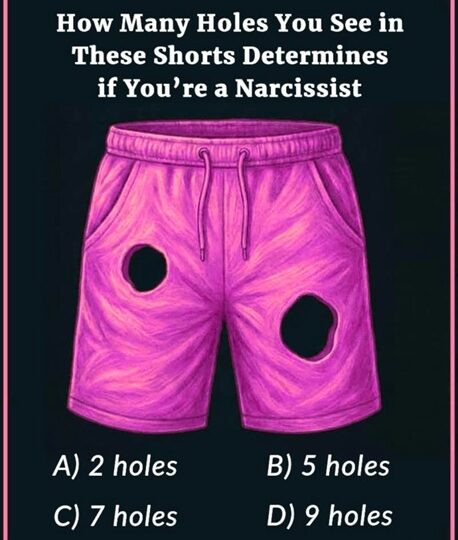
Despite the dramatic framing, the image does not diagnose narcissism, nor does it reveal personality traits. Instead, its popularity highlights something far more universal:
how differently people perceive the same visual information, how quickly the human brain reaches conclusions, and how strongly people defend their interpretations once they commit to an answer.
Why the Image Feels Like a Psychological Test
The caption plays a crucial role in shaping how people respond. By suggesting that the number of holes someone sees reflects narcissism—a term loaded with emotional and social weight—it introduces an element of judgment.
Viewers are no longer simply counting holes; they are subconsciously assessing what their answer might say about them.
Psychologically, this taps into several well-known cognitive tendencies:
Ego involvement: People want to believe their answer reflects intelligence or insight.
Social comparison: Viewers compare their response with others in the comments.
Fear of misjudgment: No one wants to be labeled narcissistic or unaware.
Confirmation bias: Once someone chooses an answer, they defend it vigorously.
This framing turns a harmless visual puzzle into a miniature social experiment, even though it has no scientific diagnostic value.
The Immediate Answer: Seeing Two Holes
Most people respond almost instantly, answering “two.” They focus on the two visibly torn areas on the legs of the shorts. This reaction is not careless or wrong—it reflects how the human brain is designed to function.
The brain prioritizes salient features: shapes or disruptions that stand out visually. The tears are irregular, jagged, and clearly damaged, making them the most noticeable elements in the image.
From an evolutionary perspective, humans are wired to detect anomalies quickly, which helps explain why these holes dominate initial perception.
This type of response is often described as intuitive or instinctive thinking. It is fast, efficient, and usually reliable in everyday situations. Seeing two holes does not indicate limited intelligence or shallow thinking—it simply reflects how perception works when information is processed rapidly.
The Structural Interpretation: Counting Five Holes
As discussion grows, others begin pointing out a key detail: the shorts were designed with holes from the beginning. Specifically:
One hole for the waist
Two holes for the legs
Two additional holes caused by tearing
This brings the total to five holes, which many consider the most complete and reasonable answer.
This interpretation requires stepping back from instinctive perception and considering function and structure. It reflects a slightly more analytical mode of thinking, where the viewer redefines what qualifies as a “hole” rather than focusing only on visible damage.
Importantly, this doesn’t make the answer more intelligent or superior—it simply reflects a different cognitive approach. Both interpretations are valid within their own logical frameworks.
Going Deeper: Layered and Multi-Dimensional Counting
Some viewers take the analysis further, arguing that holes should be counted based on fabric layers and depth. Since shorts consist of front and back panels, certain holes may pass through multiple layers of material.
Depending on interpretation, this reasoning can produce answers such as seven, eight, or even nine holes. While these answers are less common, they demonstrate how flexible human reasoning can be when definitions are expanded.
At this stage, the puzzle becomes less about the image itself and more about how people define terms, apply rules, and justify their logic. There is no universally correct answer because the puzzle lacks a clear definition of what constitutes a hole.
Why the Narcissism Claim Is Misleading
The idea that seeing a certain number of holes indicates narcissism is not supported by psychology or neuroscience. Narcissistic Personality Disorder is a complex mental health condition diagnosed through clinical evaluation, not visual puzzles or internet challenges.
Labeling perception differences as narcissism is a rhetorical device—not a scientific claim. Its purpose is to provoke emotional engagement, spark controversy, and encourage sharing.
In reality:
Seeing two holes reflects instinctive visual processing.
Seeing five holes reflects structural awareness.
Seeing seven or more holes reflects layered or abstract reasoning.
None of these responses reveal personality traits, intelligence levels, or emotional characteristics. They simply reflect different cognitive pathways activated by the same stimulus.
Why People Argue So Passionately About It
What truly fuels the viral spread is not the image—it’s the comment section. Once people commit to an answer, they feel compelled to defend it. This phenomenon is well documented in cognitive psychology and is known as commitment bias.
Social media amplifies this effect by:
Displaying public replies
Encouraging likes and reactions
Rewarding strong opinions with visibility
Framing disagreement as personal challenge
As a result, a simple visual puzzle evolves into a debate about intelligence, logic, and self-awareness—even though none of those traits are actually being measured.
The Real Lesson Behind the Image
The viral shorts image succeeds because it reveals something fundamental about human cognition: we don’t all see the same thing, even when looking at the same image.
Perception is shaped by:
Attention
Context
Prior experience
Assumptions
Definitions
The puzzle works because it exposes these differences instantly and invites people to explore them—sometimes defensively, sometimes playfully.
Rather than diagnosing personality traits, the image demonstrates how easily people:
Jump to conclusions
Trust first impressions
Attach meaning to arbitrary labels
Defend personal interpretations
Why This Type of Content Thrives Online
This puzzle belongs to a broader category of viral content designed to:
Be instantly understandable
Trigger emotional reaction
Encourage debate
Require no specialized knowledge
Because it avoids political, medical, or explicit themes, it is also safe for advertising platforms, making it especially attractive for pages seeking wide distribution and monetization.
Its simplicity is its strength. Anyone can participate, everyone can argue, and no definitive answer ends the discussion.
Final Thoughts
The viral “holes in the shorts” image is not a test of narcissism, intelligence, or awareness. It is a clever example of how perception, language, and social framing interact in the digital age.
What makes it compelling is not the shorts themselves, but the way people respond to them—how quickly they decide, how strongly they defend their view, and how readily they assign meaning to a simple visual challenge.
In the end, the image doesn’t reveal who people are. It reveals how they think, how they reason, and how discussion itself becomes the real source of engagement. And that—not the number of holes—is why it continues to circulate so widely across the internet.

