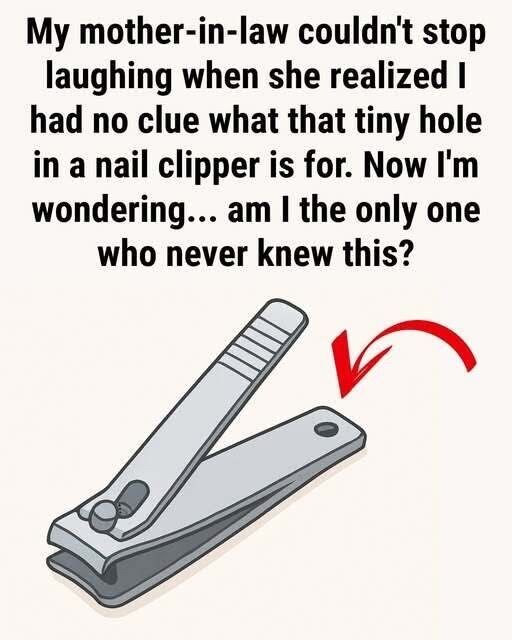
In everyday life, the objects we rely on most are often the ones we think about least. They sit in drawers, bags, or pockets, performing their roles so reliably that their presence fades into the background of routine. Human environments are filled with tools shaped not by spectacle but by repetition, adjustment, and quiet refinement. From the curve of a spoon to the ridges on a screwdriver, each element reflects accumulated decisions about comfort, efficiency, and human behavior. The nail clipper belongs firmly in this category of overlooked brilliance. It is small, affordable, and nearly universal, crossing cultures and generations with little variation. Yet within its compact form lies a tiny circular hole at the end of its lever, a detail so familiar that most people have never paused to ask why it exists. That hole is not ornamental, accidental, or arbitrary. It is the result of deliberate design choices shaped by historical habits, ergonomic needs, and manufacturing realities. Examining this one feature opens a window into how engineers and designers think about real people, real problems, and real constraints, revealing how even the simplest object can embody remarkable intelligence.
At its most visible level, the hole serves the practical purpose of portability and organization. Nail clippers are notoriously easy to lose, often disappearing into cluttered drawers, travel bags, or bathroom cabinets precisely when they are needed most. The hole solves this problem elegantly by allowing the clipper to be attached to a keyring, chain, or lanyard. This transforms it from a loose, forgettable item into a portable tool that travels alongside everyday essentials. Whether clipped to keys, hung inside a toiletry bag, or attached to a backpack zipper, the clipper becomes immediately accessible without requiring conscious effort. This feature aligns seamlessly with human behavior, recognizing that people prefer systems that reduce friction rather than demand discipline. Instead of relying on memory or organization habits, the hole provides a physical solution that works passively. It reflects a design philosophy that anticipates human imperfection and responds with simplicity rather than instruction.
Beyond portability, the hole subtly enhances usability and control, particularly for users who may struggle with grip strength or fine motor precision. By allowing a finger to pass through it, the hole offers an additional anchor point, stabilizing the clipper during use. This can be especially helpful when trimming thicker nails, such as toenails, where added leverage improves safety and accuracy. For some users, this small adjustment reduces slippage and strain, turning a potentially awkward task into a more controlled motion. In shared households or professional settings, the hole also enables easy grouping and hanging, allowing multiple clippers to be stored hygienically while remaining accessible. These ergonomic benefits are not immediately obvious, but they demonstrate how thoughtful design can accommodate a wide range of users without altering the object’s fundamental simplicity. The hole adds capability without adding complexity, an ideal balance in functional design.
The origins of this feature trace back to a time when personal tools were expected to be carried rather than stored. In the late nineteenth and early twentieth centuries, many everyday items were designed with mobility in mind. Pocket watches, small knives, keys, and grooming tools were commonly attached to chains or chatelaines, worn on the body rather than tucked away at home. Nail clippers emerged during this era as compact alternatives to grooming scissors, and their design reflected the lifestyle of the time. The hole allowed them to be secured alongside other personal items, ensuring they were always within reach. This historical context explains why the feature has persisted even as living spaces expanded and storage became more abundant. Good design tends to outlast the conditions that created it because it continues to solve fundamental problems. The hole remained useful even as habits changed, quietly adapting to new contexts without requiring redesign.
As industrial manufacturing advanced, nail clippers became standardized, affordable, and widely distributed. Despite improvements in materials, finishes, and added components such as fold-out files or cleaners, the hole endured. From a production standpoint, it also serves practical purposes, aiding in alignment, handling, and consistency during manufacturing and packaging. This dual usefulness, benefiting both the maker and the user, contributes to its longevity. Features that offer value across multiple stages of an object’s life cycle are rarely removed, because doing so would require sacrificing efficiency for minimal gain. The persistence of the hole reflects a broader principle in industrial design: elements that serve more than one function tend to survive trends, cost-cutting, and stylistic shifts. The nail clipper’s evolution demonstrates restraint rather than reinvention, refining what works instead of chasing novelty.
What makes this detail especially compelling is how completely it avoids drawing attention to itself. The hole does not advertise its purpose, nor does it demand explanation. It exists quietly, waiting to be used by those who notice it and ignored by those who do not, without diminishing the object’s effectiveness either way. This is the hallmark of truly successful design. It integrates so seamlessly into daily life that it becomes invisible, even as it continues to solve problems. In an age often defined by complexity, smart technology, and constant updates, the nail clipper offers a counterpoint. It reminds us that innovation does not always mean adding features or layers of intelligence. Sometimes it means understanding human behavior deeply enough to remove obstacles with the smallest possible intervention.
Ultimately, the small hole on a nail clipper is a testament to the power of accumulated wisdom in design. It represents generations of observation, adjustment, and respect for how people actually live. This single, unassuming feature improves portability, enhances control, supports manufacturing efficiency, and connects modern users to historical habits of everyday life. It proves that even the most ordinary objects can carry extraordinary intention, and that simplicity, when thoughtfully executed, is not the absence of design but its highest expression. The next time a nail clipper is picked up without a second thought, that tiny hole stands as quiet evidence that good design does not need to be loud to be lasting.