I was a live-in nurse for a grumpy old man for 10 years. When he passed away, his kids threw me out without even paying my final salary. 5 days later, his son called in a panic. “Get here NOW!” I went, thinking karma had finally hit them.
But I froze when I saw under his dad’s bed.
There, pushed deep into the shadows as if it had been hidden for years, was a small, old-fashioned wooden box. It wasn’t locked, but it was wrapped in a faded cloth, the kind people use to protect something they consider important. Dust had gathered around it, untouched, unnoticed.
Ryan, the son who had thrown me out just five days earlier, stood behind me, breathing unevenly.
“We didn’t put that there,” he said quickly. “We’ve already cleared the room once. That… that wasn’t there before.”
I didn’t answer. I stepped closer, my heart beating faster than I wanted to admit. Something about the box felt intentional, not forgotten.
I knelt down slowly and pulled it out.
It was heavier than it looked.
“Open it,” Ryan urged, his voice tight.
I hesitated for just a second, then lifted the lid.
Inside, neatly arranged, were stacks of documents tied with string, a small velvet pouch, and a sealed envelope with my name written on it.
My name.
For a moment, the room went completely silent.
I picked up the envelope with shaking hands. The handwriting was unmistakable. I had seen it every day for ten years—on medicine schedules, grocery lists, small notes left on the kitchen counter.
It was his.

Mr. Halvorsen.
The “grumpy old man” everyone else had given up on, but the man I had cared for through every bad night, every stubborn refusal, every quiet moment when he thought no one was looking.
“Read it,” Ryan said again, softer this time.
I opened the envelope carefully.
Inside was a letter, written in his familiar, slightly uneven script.
“If you are reading this, it means my children have already shown you who they are.”
My throat tightened.
“I am not a kind man by nature, and I know I have not always been easy to live with. But I am not blind. I have seen who stayed and who didn’t. I have seen who cared, and who only visited when it was convenient.”
My eyes blurred, but I kept reading.
“For ten years, you were there. Not because you had to be, but because you chose to be. You treated me with dignity when I did not always deserve it. You spoke to me when everyone else stopped listening.”
I pressed my lips together, trying to steady myself.
“So I have made arrangements. Everything you need to know is in this box. Do not let anyone take what is yours.”
I lowered the letter slowly.
Ryan stepped closer. “What does it say?”
I didn’t answer right away. Instead, I reached into the box again and pulled out the documents.
Legal papers.
Official.
Stamped.
I didn’t need to read every line to understand.
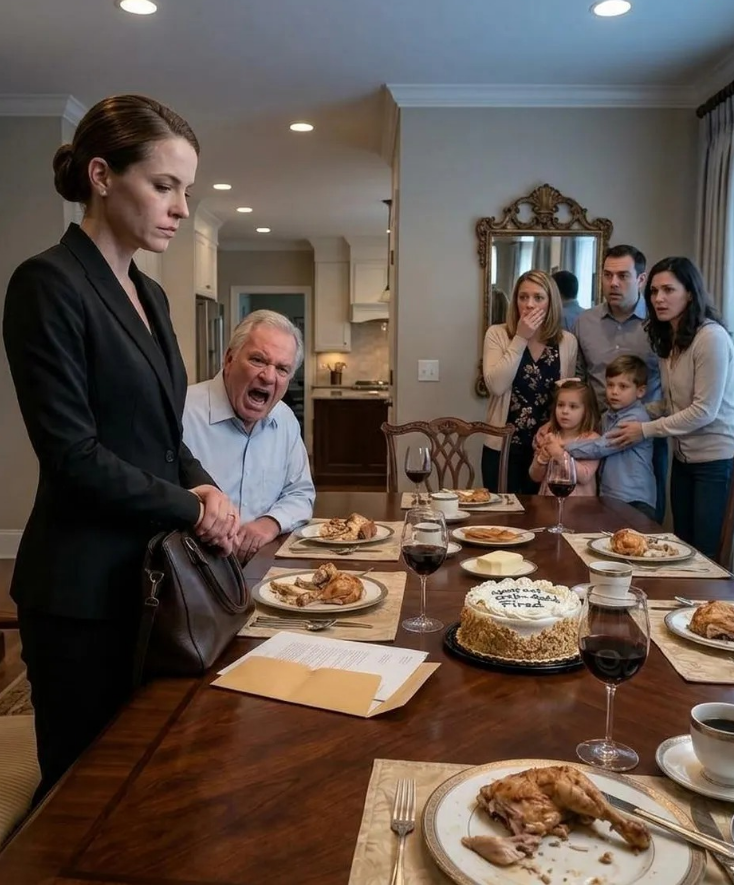
But I did anyway.
And when I finished, my hands went still.
“What is it?” Ryan asked, his voice now edged with something else—fear.
I looked up at him.
“Your father didn’t leave everything to you,” I said quietly.
His face went pale.
“What do you mean?”
I held up the document.
“He left this house,” I said, “to me.”
Silence crashed into the room.
His sister, who had been standing in the doorway, let out a sharp, disbelieving laugh. “That’s not possible.”
“It is,” I replied calmly.
I handed the papers to Ryan.
“He transferred ownership months ago. Legally. Witnessed. Filed.”
Ryan flipped through the pages, his hands trembling.
“No,” he muttered. “No, he wouldn’t do that. We’re his family.”
I met his eyes, steady and unshaken.
“I was too,” I said.
That was when everything shifted.
Not loudly. Not dramatically.
But completely.
The panic in his voice turned into desperation. “There has to be something else. Money. Accounts. He wouldn’t just—”
“There is,” I said, nodding toward the velvet pouch.
He opened it quickly.
Inside were keys.
And another document.
A safety deposit box.
His sister grabbed it, scanning the paper. Her expression changed instantly.
“What is it?” Ryan asked.
She swallowed. “It says… it says the contents are to be divided. Fifty percent to… to her.”
She looked at me like she was seeing me for the first time.
“And the other fifty?” Ryan asked.
She hesitated.
“Donated,” she said quietly. “To a care foundation.”
The room fell silent again.
I watched them both carefully. The same people who had dismissed me, who had treated me like I was disposable, were now standing in the middle of a reality they could not control.
“You can’t just take everything,” Ryan said finally, his voice weaker now.
I shook my head.
“I’m not taking anything that wasn’t given,” I said.
There was no anger in my voice.
No need for it.
Because this was not revenge.
This was recognition.
I turned and looked around the room—the room where I had spent countless nights making sure he was comfortable, where I had sat beside him when he couldn’t sleep, where I had learned that beneath his rough exterior was a man who noticed more than he let on.
“He saw everything,” I said softly.

No one argued.
Because they knew.
Five days ago, they had thrown me out without paying me, without thanking me, without even pretending to care.
Now, they were the ones standing on uncertain ground.
I folded the letter carefully and placed it back in the box.
“I’ll give you time to process this,” I said, heading toward the door.
Ryan called after me. “Wait.”
I stopped but didn’t turn around.
“We… we didn’t know,” he said.
I closed my eyes briefly.
“I did,” I answered.
And then I walked out.
Not as the nurse they had dismissed.
But as the person he had chosen to trust when it mattered most.
And that, in the end, was worth more than anything else he left behind.
Share