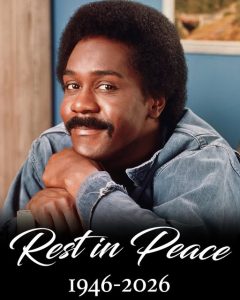
America has lost a quiet giant of television history. Demond Wilson, the actor who brought warmth, restraint, and emotional grounding to one of the most influential sitcoms of all time, has died at the age of 79. Best known for his role as Lamont Sanford on Sanford and Son, Wilson leaves behind a legacy far deeper than punchlines and catchphrases—a life defined by discipline, courage, service, and an unwavering sense of purpose.
Wilson passed away Friday morning at his home in Palm Springs, California, following complications related to cancer. The family has not disclosed the specific type. His son, Demond Wilson Jr., confirmed the news, describing his father simply and powerfully: “I loved him. He was a great man.”
To millions of viewers, Demond Wilson was Lamont Sanford—the patient, level-headed son constantly navigating the chaos created by his father, Fred Sanford. But behind the calm reactions and impeccable comedic timing was a life that had already contained more intensity, hardship, and experience than most people encounter in a lifetime.
Born in Valdosta, Georgia, in 1946, Wilson was raised in New York City, where his talent emerged almost immediately. By the age of four, he had already appeared on Broadway, a feat that hinted at both his natural ability and his early discipline. As a child, he also performed at Harlem’s legendary Apollo Theater, dancing alongside seasoned entertainers long before most children understand what a stage even is. Those who worked with him at the time noted his seriousness and focus—traits that would remain with him for the rest of his life.
Despite early success, Wilson made a decision that surprised many around him. As a teenager, he stepped away from acting altogether. Later in life, he explained that he wanted to experience something closer to a “normal” life, away from the pressures and expectations placed on child performers. That choice led him far from bright lights and applause—and straight into one of the most defining chapters of his life.
In the mid-1960s, Wilson enlisted in the United States Army. He served as a sergeant with the 4th Infantry Division during the Vietnam War, where he saw active combat in Pleiku. The experience was brutal and transformative. Wilson was wounded in action and later awarded both a Purple Heart and a Bronze Star for bravery. Those years left a permanent mark on him, shaping his worldview, his faith, and the gravity he brought to his later performances.
After returning home, Wilson made the deliberate decision to return to acting. He resumed his studies, rebuilt his career slowly, and took on roles that allowed him to grow rather than chase instant fame. That patience paid off in 1972, when NBC premiered Sanford and Son.
Cast opposite the legendary Redd Foxx, Wilson was tasked with a deceptively difficult role. Foxx’s Fred Sanford was loud, abrasive, impulsive, and unforgettable. Lamont, by contrast, needed to be grounded, restrained, and emotionally credible. The success of the show depended on that balance—and Wilson understood it instinctively.
He once admitted that he was initially skeptical about working with Foxx, whose stand-up comedy was famously raw and confrontational. “It would be like bringing a dog to a cat party,” Wilson later joked, expressing concern that Foxx’s edge might overwhelm the show. Producers briefly considered casting Richard Pryor as Lamont, but Wilson argued against it. Two comedians, he believed, would tip the scale too far. What the show needed was contrast—a straight man capable of anchoring the chaos.
That insight proved crucial. Sanford and Son became a ratings powerhouse and a cultural landmark, running for five seasons and remaining in syndication decades later. At a time when American television rarely centered Black working-class families, the show did so unapologetically. It portrayed frustration, love, conflict, and humor as inseparable parts of life. While Foxx delivered the explosive lines, it was Wilson’s reactions—his weary looks, his quiet patience, his barely concealed affection—that gave those moments weight.
For many viewers, Lamont Sanford was the emotional core of the series. He absorbed his father’s bluster, carried the responsibility, and represented a generation caught between obligation and independence. Wilson played the role with remarkable restraint, understanding that sometimes the most powerful performance is the one that doesn’t demand attention.
After Sanford and Son ended in 1977, Wilson continued working steadily in television and film. He later appeared on shows such as Girlfriends and remained connected to the industry, though he never chased the spotlight with desperation. In 2009, he offered a candid look at his experiences in his memoir, Second Banana: The Bitter Sweet Memories of the Sanford & Son Years. The book reflected honestly on fame, frustration, gratitude, and the complexities of being forever linked to one iconic role.
Away from the screen, Wilson lived a life defined by stability and conviction. He was married for more than fifty years to former model Cicely Johnston, with whom he raised six children. Friends described him as thoughtful, principled, deeply private, and guided by faith. Fame, for him, was secondary to family, service, and personal integrity.
Demond Wilson’s legacy cannot be measured solely by laughs or reruns. He embodied a rare combination of experiences: a child performer who chose to walk away, a soldier who faced war and survived, a wounded veteran who returned to art, and an actor who understood the power of restraint. He helped redefine what sitcoms could be and who they could center, at a time when representation carried real risk.
Long after the laughter fades, his contribution endures—not just in television history, but in the example of a life lived with discipline, courage, and quiet strength.