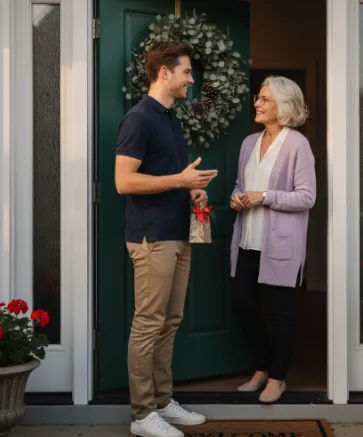
The knock on my door arrived without warning, sharp and deliberate, cutting through an otherwise ordinary afternoon. When I opened it and saw a teenage girl standing there, backpack slung awkwardly over one shoulder, I had no idea that my life was about to fracture and realign all at once. When she said, “I’m your granddaughter,” the words sounded unreal, as though they belonged to a story someone else was living. Yet everything about her felt familiar—the tilt of her head, the guarded hope in her eyes, the way she stood as if ready to retreat at the first sign of rejection. In that moment, memories surged forward: my daughter at seventeen, trembling in my kitchen, hands clenched as she told me she was pregnant. I remembered my own fear back then, layered with resentment I’d carried for years. I had convinced myself that motherhood had stolen my youth, my freedom, my chance at a different life. And when history repeated itself, I reacted not with compassion, but with bitterness. I told her she couldn’t stay. I watched her leave. I told myself it was necessary. Standing there now, faced with the living proof of what I’d turned away, I felt the weight of every year that had passed without forgiveness.
As my granddaughter spoke, her voice steady but fragile, the truth unfolded in pieces I wasn’t prepared to hear. She told me about the stories her mother shared—stories where I was not a villain, but a complicated woman shaped by hardship and survival. She told me how, year after year, my daughter had returned to this street, standing across from the house she once lived in, never daring to knock. I imagined her there, watching the lights in the windows, wondering if I ever thought of her, if I ever regretted my words. When my granddaughter explained that her mother believed she didn’t deserve to disturb my peace, something inside me cracked. I had framed my decision as strength, as self-preservation, but all I had done was teach my child that love was conditional. I saw then how fear had guided my choices—fear of repeating my pain, fear of sacrifice, fear of losing myself again. And in trying to protect my younger self, I had abandoned my daughter when she needed me most.
When I ran down the street toward the bus stop, my chest burned and my legs shook, but I didn’t slow down. Sixteen years of silence pressed against me with every step. When I saw her standing there—older, tired, but unmistakably my daughter—the distance between past and present collapsed. Her face held the same uncertainty I’d seen the day she left, and I knew I could never undo what I’d done. All I could do was choose differently now. When I pulled her into my arms, the apology spilled out of me in broken sobs. She cried too, and in that shared grief, something long frozen finally thawed. That night, as we talked until dawn, I learned about the life she’d built without me. I learned how she’d struggled, how she’d found strength not because the road was easy, but because she had no other choice. I saw the cost of my absence written into her resilience. And still, she sat across from me with compassion in her eyes, listening as if I were the one who needed reassurance.
The kitchen felt different with all three of us there, laughter and tears overlapping, the past no longer avoided but examined honestly. My granddaughter watched us with quiet relief, as if afraid the moment might vanish if she moved too suddenly. When she hugged me before leaving and whispered, “She never stopped being your daughter,” I realized how much grace I had been given—grace I had not earned, but desperately needed. That night, after they left, I barely slept. I sat at the table long after the dishes were cleared, replaying every version of my life that might have existed if I’d chosen love instead of fear. For the first time, I allowed myself to mourn—not just the years I believed motherhood had taken from me, but the years I had willingly given up by holding onto anger.
The phone rang before sunrise, its sharp sound slicing through the fragile calm of the morning. The voice on the other end was careful, professional, and unfamiliar. I knew before the words came that something was wrong. There had been an accident. My daughter had been hit by a car on her way home. She was alive, the voice assured me, but injured—seriously. The world tilted. I dressed without thinking, my hands shaking as I grabbed my keys. At the hospital, I sat beside her bed, watching the rise and fall of her chest, memorizing her face as if afraid it might disappear again. When she woke and saw me there, tears slid silently down her cheeks. I took her hand and held it, refusing to let go. In that sterile room filled with machines and quiet beeping, I understood the cruel truth: reconciliation is precious because it is never guaranteed time. Love delayed is love endangered.
Recovery was slow, but it gave us something we’d lost—time. Time to talk, to listen, to rebuild. I helped with my granddaughter, learned her routines, her dreams, her fears. I watched my daughter become both strong and soft in ways I’d never allowed myself to be. I apologized again and again, not because I expected forgiveness, but because naming my failure mattered. And slowly, something new took shape. Not a perfect family, not a rewritten past, but a present grounded in honesty. I learned that youth isn’t stolen by love—it’s transformed. And regret doesn’t come from sacrifice; it comes from withholding what we were afraid to give. The knock on my door had not just introduced me to my granddaughter. It had forced me to face the version of myself I had been running from, and offered me one final chance to choose differently.
Summary
After forcing her pregnant teenage daughter to leave years earlier, a woman is confronted by her granddaughter, reopening sixteen years of silence and regret. Through painful truths, reconciliation, and an unexpected crisis, she learns that fear—not motherhood—had shaped her choices, and that forgiveness can still rebuild what was once broken.

